
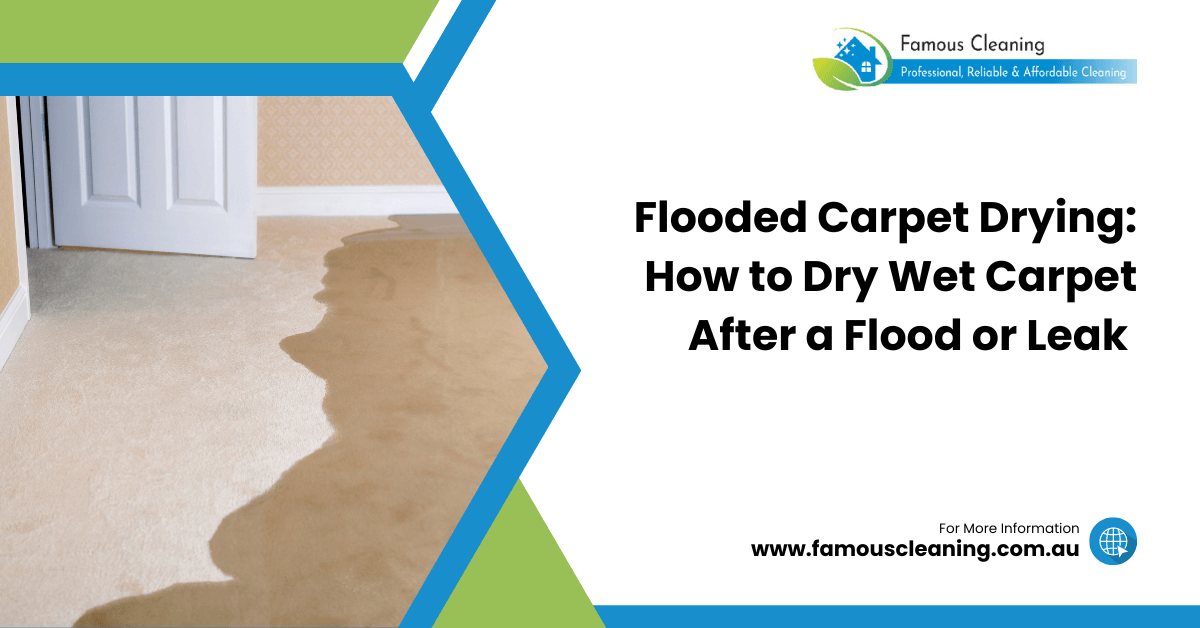
Flooded Carpet Drying: How to Dry Wet Carpet After a Flood or Leak
10 June, 2023 | Famous Cleaning
There’s nothing quite like that sinking feeling when you step onto your carpet and—squelch.
Your foot sinks in. Water oozes up. And for a second, you just stare at it thinking, “Seriously? Today?”
Whether it’s a burst pipe, a leaking washing machine, an overflowing bathroom, or one of Adelaide’s surprise summer downpours, a flooded carpet is a race against the clock. Water doesn’t just sit there. It seeps. It hides. It breeds mould like it’s hosting a party.
At Famous Cleaning, we’ve spent over a decade restoring water-damaged carpets across homes, clinics, schools, gyms—you name it. And we’ve seen every type of flooded carpet disaster you can imagine. That’s why this updated guide walks you through exactly how to dry wet carpet quickly, what you can safely do yourself, and when it’s time to call the pros.
Let’s get that carpet dry—properly.
What to Do When Carpet Is Flooded (First 10 Minutes
Before anything else, act fast. The first few minutes determine whether your carpet survives or ends up in landfill.
1. Stop the water source
- Turn off the mains if a pipe burst.
- Switch off appliances if they’re the cause.
- If it’s stormwater, create barriers or move furnishings.
2. Remove furniture ASAP
Wood swells. Metal rusts. Fabric absorbs.
Get everything off the wet area—even light chairs or mats.
3. Blot or extract standing water
This is where most DIY attempts fall short. Towels help, but a wet vac helps a whole lot more. Scoop up as much surface water as you can before it soaks deeper into the underlay.
How to Dry Wet Carpet at Home (Step-by-Step)
These are the steps we follow professionally—simplified so homeowners can handle mild to moderate water damage themselves.
Step 1: Extract as Much Water as Possible
This is the foundation. Without proper water extraction, everything else is pointless.
You can use:
- A wet/dry vacuum
- Thick towels
- Mop and bucket
- A carpet extractor (you can hire one if needed)
Avoid gimmicks like “pour rice over carpet”. It doesn’t work. It just makes a mess.
Goal: Get the carpet from “squishy” to “damp”.
Step 2: Boost Airflow — Fans, AC, and Open Windows
Airflow is your best friend.
It helps dry carpet quickly and prevents humidity from settling in the underlay.
Turn on:
- Pedestal fans
- Ceiling fans
- Air conditioners (set to dry mode if available)
Crack open windows if the weather isn’t humid.
If your carpet feels cool to the touch hours later, it’s still damp deep down.
Step 3: Use a Dehumidifier (It’s a Game Changer)
When customers ask us “What’s the best way to dry wet carpet?”, this is usually the answer.
A dehumidifier pulls moisture out of:
- The carpet
- The underlay
- The walls
- The air
It’s essential after flooded carpet situations because Adelaide’s humidity can trap moisture even when the top layer feels dry.
Step 4: Apply Baking Soda to Draw Out Deep Moisture
Baking soda won’t fix a flooded carpet, but it does help with mild dampness.
Sprinkle a generous amount over the affected area, wait 12–24 hours, then vacuum it up.
It’s cheap, safe, and surprisingly effective for lingering odours.
Step 5: Steam Clean the Carpet
After everything is mostly dry, steam cleaning helps by:
- Killing bacteria
- Reducing mould spores
- Removing smells
- Restoring texture
We steam clean carpets after almost every flood job because moisture carries dirt and contaminants with it. Even clean-looking carpets aren’t really clean after flooding.
Step 6: Inspect the Underlay
Here’s the truth:
If the underlay is soaked, the carpet may look fine but still grow mould silently underneath.
How to check:
- Lift a corner of the carpet
- Feel the padding
- Smell for mustiness
If the padding is still damp 24–48 hours after drying efforts, it might need replacing.
We routinely replace underlays during restoration because it's often cheaper than salvaging them.
Step 7: Call a Professional for Heavy Damage
If your carpet:
- Has been soaked for more than 12 hours
- Smells musty
- Shows signs of mould
- Has soaked walls or skirting
- Covers a large area
…it’s time to call in the pros.
We use industrial-grade:
- Water extractors
- Commercial dehumidifiers
- Air movers
- Steam cleaning systems
And we’re available 24/7 with Same Day Service, so you’re not stuck waiting.
How to Dry Carpet After a Water Leak (Simple vs. Severe Cases)
Minor Leak
Like a spilled bucket or AC drip.
- Towel dry
- Turn on fans
- Use baking soda
- Done in a few hours
Moderate Leak
Like a washing machine overflow.
- Extract water
- Run fans + AC
- Add a dehumidifier
- Steam clean
- Monitor underlay
Severe Flooded Carpet
From stormwater, burst pipes, or standing water.
- Remove large volumes of water
- Lift carpet edges
- Dry underlay separately
- Industrial fans & dehumidifiers
- Treat mould
- Steam clean
- Replace underlay if needed
DIY helps, but full restoration usually requires professional equipment.
How to Dry Damp Carpet Fast (Professional Tips)
Here are a few tricks we use on jobs:
1. Create a cross-breeze
Open windows across the room, not next to each other.
Air needs to travel, not swirl.
2. Lift the carpet edges
We call this “tenting”.
It lets air circulate directly under the carpet—much faster.
3. Use heat carefully
Warm air helps… but don’t blast heaters.
Too much heat can shrink carpets or damage fibres.
4. Don’t walk on the wet carpet
You’ll push moisture deeper into the padding.
Plus, if the water is dirty, it spreads contaminants.
You can also read: Water Damage Carpet Cleaning Services in Adelaide
FAQs: Quick Answers You Actually Need
How do I dry wet carpet quickly?
Extract water → fans/AC → dehumidifier → baking soda → steam clean.
What’s the best way to dry a flooded carpet?
Industrial extraction + high-powered air movers + commercial dehumidifiers.
How long does it take to dry carpet after a water leak?
Anywhere from 6 hours to 3 days depending on severity.
Can a carpet be saved after a flood?
Yes—if treated within 24–48 hours.
After that, mould becomes a serious risk.
Is it safe to keep wet carpet?
No. Even small damp patches can grow mould in hidden layers.
Final Takeaway: Don’t Wait — Wet Carpet Doesn’t Fix Itself
Because here’s the thing:
Water damage is sneaky. It hides in the underlay. It seeps under walls. It invites mould long before you smell it.
Drying a carpet properly isn’t just about saving flooring—it’s about protecting your home and health.
If you’re dealing with a flooded or water-damaged carpet in Adelaide and want it done fast and done right, we’re here 24/7.